
When Does a Baby Actually Need Their First Shoes?
Walk into any baby shop and you will be told your newborn needs shoes. Walk into any paediatrician's office, and you will be told the opposite. So what is actually true?
The shortest answer
A baby needs their first real shoes when they start walking reliably outdoors — not a day earlier. Indoors, barefoot or soft socks are almost always the better choice. This is the consensus of the American Academy of Pediatrics and of most peer-reviewed pediatric podiatry research.
The pre-walker phase: soft or nothing
Before walking, a baby's foot is still mostly cartilage. The muscles and ligaments are learning to map the ground. External stiffness — from hard-soled booties, thick socks, or structured baby shoes — can actually slow that mapping down. The best things you can put on a pre-walker's foot, in order, are: nothing, a soft sock, a glove-thin leather bootie. Skip everything else.
The first walker phase
The first walker stage is short and magical. It begins with that wobbling, arms-out step across the living room and settles into confident waddling a few months later. During this window, indoor walking should still be barefoot or in socks when safe. Outdoor walking — gravel, warm pavement, cold tiles — is where real shoes finally earn their place.
What to look for in a true first walker:
- Paper-thin, flexible sole. You should be able to bend it in half with one hand.
- Wide, foot-shaped toe box. Place the shoe beside your child's foot — if the shoe is narrower than the foot, it is wrong.
- Zero heel drop. The heel and toe of the sole should be the same height.
- Soft, breathable upper. Natural leather is ideal.
- Light. A baby shoe should weigh almost nothing.
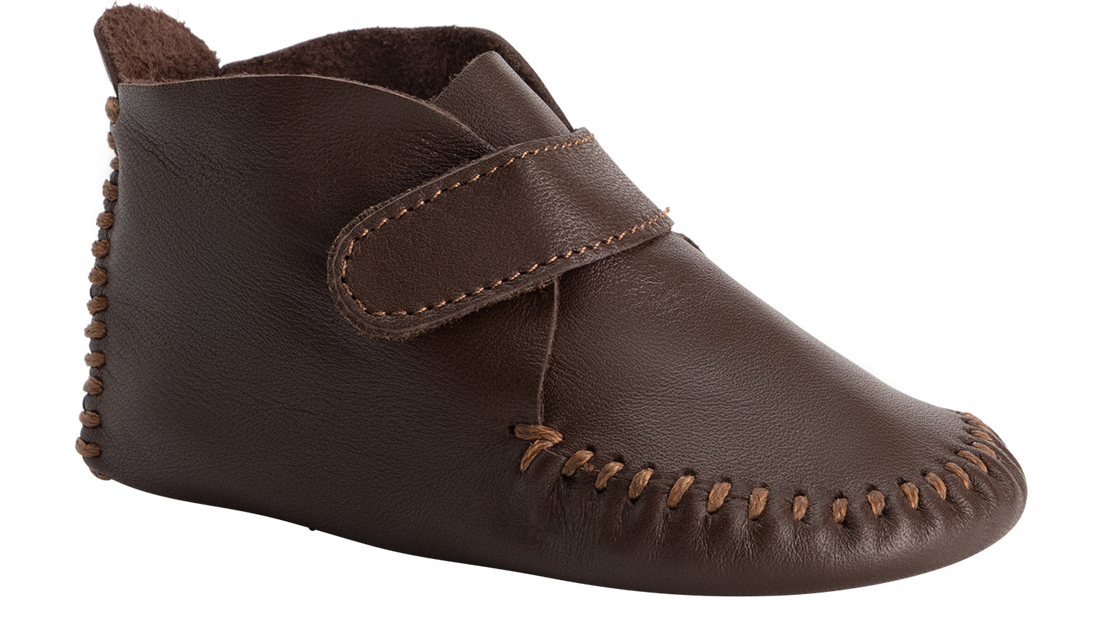
Our Earthy First Steps was designed exactly for this. The leather is vegetable-tanned. The sole bends in half. The closure is either a soft velcro strap (for everyday life) or a lace (for special days). EU 19–21.
Indoor versus outdoor
For indoor use almost nothing beats bare feet. A close second is a soft leather shoe. Once your child starts going outside on their own feet regularly, you want a first walker with a slightly more protective — but still flexible — sole. Look at our broader Tiny Earth collection for the full picture.
What happens if they wear shoes too early
Pediatric research is consistent on this: shoes worn before walking do not help walking. They can slightly delay the development of foot musculature and proprioception. The forefoot may narrow under even light pressure. The toes may curl rather than splay. None of these are catastrophes — baby feet are resilient — but none of them are what you want either.
What to actually buy (or not buy)
Before walking: a pack of soft socks and maybe one pair of soft leather booties for colder months or formal settings. That is all.
At the first reliable steps outdoors: one pair of minimalist first walkers with room to grow. Measure the foot, add 10 mm, buy the next size up.
The AMUMIN recommendation
We built Earthy First Steps precisely because almost every baby shoe we saw was wrong: too stiff, too narrow, too heavy, too lifted. Our version is what we give our own babies. Read our deeper complete guide to barefoot shoes for kids, or learn exactly how to measure a child's foot the AMUMIN way. You can also check our size guide before buying.
And if today is still the pre-walker phase? Enjoy those soft little feet. They do not need anything yet.