
Barefoot Shoes for Kids: From First Steps to School Age
Your child's feet are a marvel of nature. At birth, a baby foot contains no bones at all — only cartilage, soft tissue, and enormous potential. The 26 bones that will eventually form the adult foot are still being sculpted by every step, every stretch, every curious wiggle of tiny toes. That is why what goes on your child's feet is never a small decision.
At AMUMIN we hand-sew natural leather barefoot shoes for the smallest feet in the family, and we hear one question more than any other from parents: are barefoot shoes really better for my child? This guide — our most comprehensive to date — is our answer.
Why barefoot shoes for children?
The philosophy of barefoot footwear is simple: shoes should protect the foot without interfering with its natural development. A child's foot needs three things to grow strong: space to spread, freedom to flex, and sensory feedback from the ground. Conventional children's shoes — with stiff soles, raised heels, narrow toe boxes, and so-called "arch support" — interrupt all three.
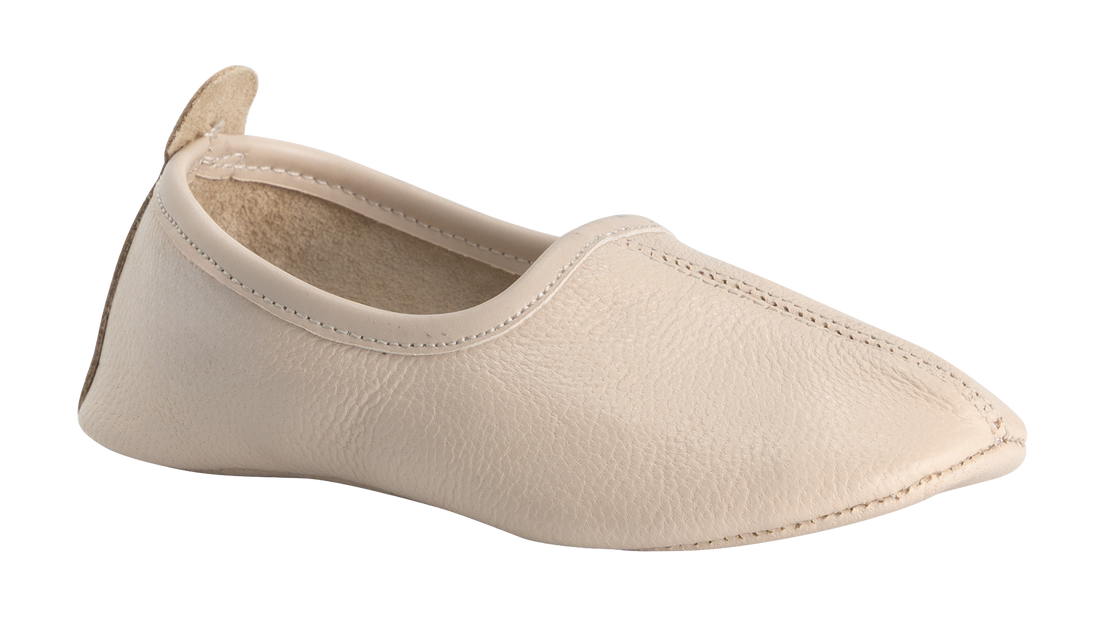
A barefoot shoe, by contrast, is built around the shape of a real foot. The toe box is wide. The sole is thin and flexible. There is zero heel-to-toe drop. The upper is soft and breathable. Our Tiny Earth collection — /collections/tiny-earth-collection — is designed from this principle up.
The anatomy of a child's foot: baby to schoolchild
0–12 months: all cartilage
A newborn's foot is almost entirely cartilage. Ossification — the gradual conversion of cartilage to bone — continues until roughly age 18. During the first year, the foot is extraordinarily malleable. Podiatric research consistently shows that even mild external pressure can deform the soft structures of a pre-walker foot. Tight socks, stiff booties, or shoes worn before walking can all leave their mark. In these months, the best footwear is simply no footwear, followed by soft socks and — when protection is needed — a glove-like leather shoe.
1–3 years: the first walker
When a toddler pushes up and takes those first wobbling steps, the foot begins to develop its arch, its intrinsic muscles, and its proprioceptive map. Comparative research on children raised with versus without habitual shoe-wearing has shown measurable differences in foot shape, toe spread, and balance — barefoot-raised children tend to have wider forefeet and stronger static balance.
This is the window in which our Earthy First Steps and Earthy Rise models do their quiet, essential work. The sole is thin enough for the child to feel the ground. The leather hugs the foot without squeezing it. There is no hidden support — because the support a toddler needs is the support they are building from the inside out.
3–12 years: the school-age foot
By age three, most children have a recognisably adult-shaped foot in miniature. The arch is forming. The bones are beginning to ossify. But development is far from finished. The American Academy of Pediatrics notes that the child's foot continues to mature well into adolescence, and that poorly fitting footwear during these years is associated with hallux valgus, hammer toes, and altered gait patterns in adulthood.
What the research actually says
Pediatric podiatry research on barefoot development has converged on a few clear findings over the past decade:
- Toe splay matters. Narrow footwear literally reshapes the forefoot. Research comparing forefoot width in habitually-shod versus minimally-shod children has reported narrower forefeet in the shod group by school age.
- Sensory feedback drives motor learning. The sole of the foot is one of the densest concentrations of mechanoreceptors in the human body. A thin, flexible sole allows these receptors to do their work; a thick cushioned sole mutes them.
- "Arch support" is rarely what a developing foot needs. Reviews of pediatric flatfoot conclude that the vast majority of flexible flatfeet in children are a normal developmental stage and require no corrective support.
First steps: the Earthy First Steps model
For babies aged roughly 0–2, we made Earthy First Steps in two closures: a soft velcro strap for daily use, and a traditional lace version for special days. The leather is vegetable-tanned, the sole is paper-thin, and the toe box is generous — because a first-walker foot needs room to wiggle into balance. See Earthy First Steps in brown.
Toddler days: Earthy Rise
Between roughly 1 and 3 years, toddlers need a little more protection for indoor adventures — kitchen tiles, garden stones, the occasional enthusiastic jump. Earthy Rise keeps the minimalist philosophy but adds slightly more grip on the sole and a reinforced toe. Available in black, brown and caramel, EU 19–21.
Age 3–12: Mini Sereen
For children from three to twelve, Mini Sereen is our indoor leather shoe — soft, foldable, and warm. EU 23–35, in black, brown and cream.
How to measure a child's foot
Children's feet grow fast, and they grow unevenly. We recommend measuring every 8–10 weeks during the first three years, and every three months thereafter. A simple method:
- Have your child stand on a sheet of paper, heels flush against a wall.
- Mark the longest toe (usually but not always the big toe).
- Measure from the wall to the mark in millimetres.
- Add 10 mm for growing room.
For the full AMUMIN method including model-specific size charts, see our size guide.
When to replace children's shoes
A child's foot can grow a full size in under three months. Signs it is time to size up: red marks on the toes or heels, the child curling their toes, visible pressure at the toe box, or simply less than 8 mm of growing room when you measure. Do not wait for complaints — young children often cannot articulate that their shoes hurt.
FAQ for parents
Are barefoot shoes safe for babies who aren't walking yet? Yes, but pre-walkers rarely need shoes at all. If you want something for warmth or social settings, look for the softest possible leather with no heel and no structure.
Will my child fall more in barefoot shoes? Research suggests the opposite: children in minimal footwear typically show better static and dynamic balance than peers in cushioned shoes.
What about cold weather? Our leather is naturally insulating, but for outdoor winter use we recommend pairing with wool socks or choosing a thicker barefoot model.
My paediatrician recommended arch support — should I ignore AMUMIN? Never ignore your paediatrician. Discuss the research with them. Most paediatric podiatrists today agree that flexible flatfoot in children under six is developmental and self-correcting. If your child has a specific diagnosis, follow medical advice first.
Ready to start? Explore the full Tiny Earth collection, read our companion piece on when babies actually need their first shoes, or learn our exact measuring method.