
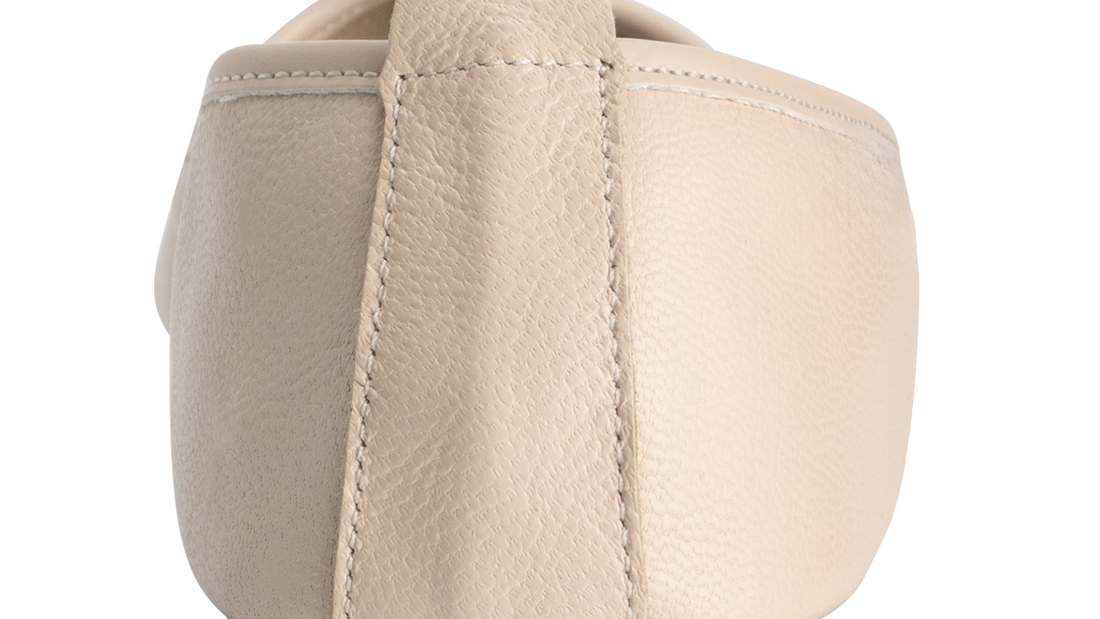
Handmade Leather in Barefoot Shoes — What Makes It Different?
Why the material question matters
It is possible to put excellent barefoot design — wide toe box, zero drop, thin flexible sole — inside a synthetic mesh shoe. Many brands do. The shoe will still let your foot move the way it wants. But a mesh shoe cannot mould to the individual foot, does not breathe the way a natural hide does, and will be in a bin in two years.
At AMUMIN we chose leather for barefoot footwear because the relationship between a well-tanned hide and a living foot is different from the relationship between polyester and a foot. The leather remembers. It adapts. It lasts. This article explains what "handmade vegetable-tanned leather" really means and why it matters for a barefoot shoe specifically.
For the wider context on barefoot design, read our complete guide to barefoot shoes.
What is vegetable-tanned leather?
Tanning is the process that stops a hide from rotting and turns it into a durable material. There are two main industrial methods: chrome tanning and vegetable tanning. More than 80 percent of the world's leather is chrome-tanned, because it is fast and cheap — the process takes about a day and uses chromium salts. The hide is slowly soaked in progressively stronger tannin baths. The result is a leather that is denser, stiffer when new, warmer in the hand, honeyed in smell, and which develops a patina over years rather than flaking apart after one.
You can usually tell the difference by touch and smell. Chrome-tanned leather smells vaguely chemical and feels uniform. Vegetable-tanned leather smells like wood and earth and has subtle variations across the hide.
The difference for barefoot shoes specifically
Why does tanning matter for a barefoot shoe? Three reasons.
1. It moulds to your individual foot
A barefoot shoe is, by definition, close to your foot. There is no padding layer between your skin and the material. Over the first few weeks of wear, your body heat and moisture cause vegetable-tanned leather to slowly relax into the exact shape of your foot — every bunion, every arch, every little asymmetry. Chrome-tanned leather resists this; it is engineered to stay dimensionally uniform, which is excellent for mass-produced fashion shoes and a slight compromise for a barefoot shoe. Your foot is not dimensionally uniform.
2. It breathes
A natural, minimally-treated hide exchanges moisture with the air around it. In a barefoot shoe, with no cushioned layer to trap sweat, this matters: the foot stays drier, fungi have less to work with, and the shoe does not develop that sour smell a synthetic indoor shoe acquires by month three.
3. It lasts
A properly made vegetable-tanned leather shoe, worn daily, should last two to four years before the upper shows serious wear. The soles are independently replaceable. A synthetic alternative in the same price range lasts one season.
How AMUMIN chooses its leather
We work with a small number of European tanneries that still run the long, slow vegetable tanning process. Our main criteria:
- Thickness and density appropriate for the shoe. Thicker for the Terra outdoor sneaker, softer and more supple for the Sereen indoor shoe.
- Origin and traceability — we want to know which tannery, which batch, which region.
- Chrome-free certification. Vegetable tanning cannot, by definition, include chromium.
- Softness for children. Our children's collection — Mini Sereen, Earthy Rise, Earthy First Steps — uses the softest, most pliable hides we can find, because children's skin deserves more than an adult's.
How leather moulds to your foot
In the first week, a new pair of AMUMIN shoes may feel firm in one or two spots — often over a bunion or a prominent metatarsal head. This is the leather and the foot introducing themselves. Over the next two to three weeks, the leather relaxes at exactly those points, creating a micro-fitted shoe that is different on your left foot than on your right, because your feet are different. This is why second-hand hand-made leather shoes rarely fit a second owner: the first foot has already spoken.
Care and maintenance
A vegetable-tanned leather shoe will repay simple care with years of service.
- Brush or wipe weekly. Dust is the biggest enemy of leather grain.
- Condition every 2–3 months. A pea-sized amount of neutral leather cream, massaged in with clean fingers.
- Never dry near a radiator. Wet leather that dries too fast cracks. Stuff with newspaper, air-dry at room temperature.
- Rotate pairs if you can. Leather likes a day of rest between wears to release moisture.
- Salt stains (winter) wipe off with a damp cloth and a drop of white vinegar, followed by conditioning.
Why handmade, not machine-made?
A shoe built on a factory line is identical to every other shoe on that line. A shoe made by a pair of trained hands is subtly different — the stitching sits slightly differently, the cut compensates for small variations in the hide — and that difference is what gives the shoe its character. Our cutters and stitchers work in small batches, a few pairs at a time, in our workshop. It is slow on purpose. Skill stays in the trade only if someone keeps practising it.
Sustainability, honestly
Leather is an animal product; pretending otherwise would be dishonest. We use leather that is a by-product of the food industry — hides that would otherwise be discarded. We use vegetable tanning because chromium wastewater is a documented environmental problem. And we build shoes that last years rather than seasons, because the most sustainable shoe is the one you don't replace. For further reading, the FAO's overview of leather and the environment is a sober starting point.
Our supply chain, in one paragraph
Hides from European farms → traceable vegetable tanneries in Italy and Turkey → our workshop (via Rotterdam), where cutting, stitching and finishing happens by hand. No overseas mass-production. No hidden chrome-tanned linings. When you slip into a pair of Sereen, the hide in your hand has been through a process you can trace. That is rare in footwear today, and worth defending.
Keep reading
For the full framework, see our complete guide to barefoot shoes. For the role of shape, read why your toes need room to spread.