
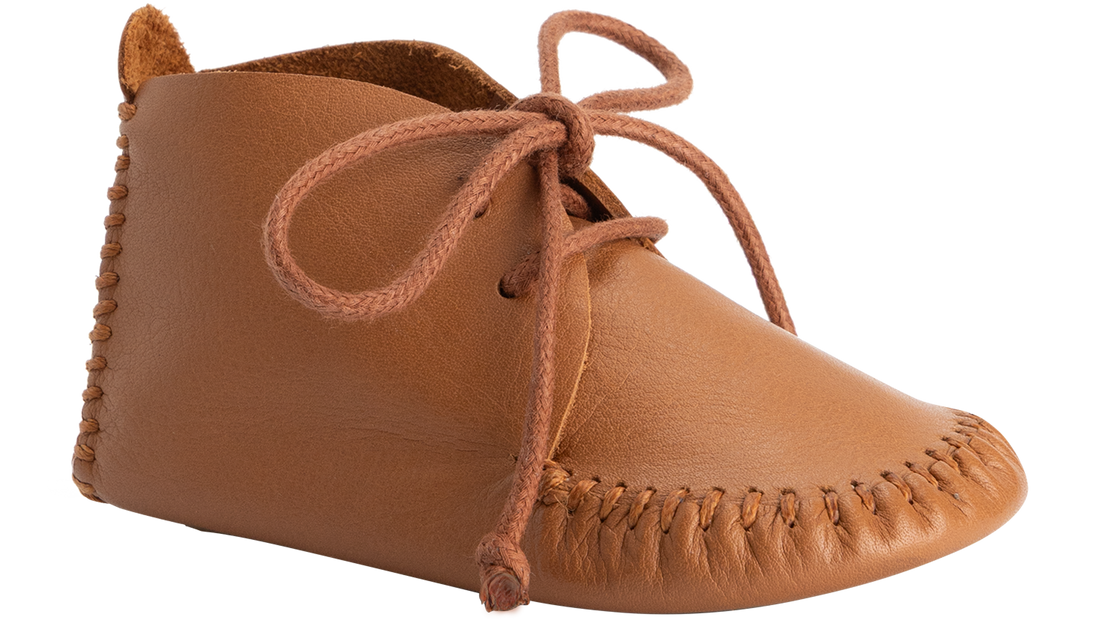
Measuring Kids' Shoe Size: The AMUMIN Method
The single most common reason children's shoes don't fit is not the brand. It's the measurement. Children's feet grow so fast that last season's size is rarely this season's size, and a foot measured sitting down looks very different from a foot under full body weight. Here is exactly how we do it at AMUMIN.
The short method in four steps
- Stand your child on a blank A4 sheet against a wall. Heels flush against the wall. Full weight on both feet.
- Mark the tip of the longest toe (usually but not always the big toe) with a pencil held vertically. Do both feet — they are often different.
- Measure from the wall edge of the paper to the mark, in millimetres. Use the longer of the two feet.
- Add 10 mm of growing room. That is the inside length your next pair of shoes should have.
That is the whole method. No digital apps, no tape measure around the foot, no guessing.
What you need
- One sheet of blank paper (A4 works for any child size).
- A pencil, held perpendicular to the paper.
- A ruler or tape measure with millimetres.
- A happy child. Afternoon measurements tend to be the most accurate — feet swell slightly over the day, and afternoon swelling is closest to how feet sit inside shoes during play.
Common mistakes
Measuring sitting down. A seated foot is shorter than a standing foot by several millimetres. Always standing.
Measuring only one foot. Children's feet are rarely identical. Always measure both and fit the longer.
Forgetting growing room. A perfectly-fitting shoe today is a too-small shoe in six weeks.
Trusting the last size. Re-measure every 8–10 weeks in the first three years, every three months thereafter.
Measuring in the morning only. Afternoon feet are bigger. Fit to afternoon feet.
EU / US / UK conversion
This chart gives the internal shoe length that corresponds to each size. Remember: add 10 mm of growing room to your measured foot length, then match to the closest EU size.
| EU | Foot length (mm) | US Toddler | UK |
|---|---|---|---|
| 19 | 115 | 4 | 3 |
| 20 | 122 | 4.5 | 3.5 |
| 21 | 128 | 5 | 4 |
| 22 | 135 | 5.5 | 4.5 |
| 23 | 142 | 6.5 | 5.5 |
| 24 | 148 | 7 | 6 |
| 25 | 155 | 8 | 7 |
| 26 | 162 | 8.5 | 7.5 |
| 27 | 168 | 9.5 | 8.5 |
| 28 | 175 | 10 | 9 |
| 29 | 181 | 11 | 10 |
| 30 | 188 | 11.5 | 10.5 |
| 31 | 194 | 12.5 | 11.5 |
| 32 | 201 | 13 | 12 |
| 33 | 208 | 1Y | 13 |
| 34 | 214 | 2Y | 1Y |
| 35 | 221 | 3Y | 2Y |
Per AMUMIN model: which size to order
Earthy First Steps (0–2 years, EU 19–21)
Our softest first walker. Run true to the length chart above. Because the leather is unlined and moulds to the foot within two or three wears, do not size up beyond the standard 10 mm growing room. If your measured foot length falls between two sizes, choose the larger.
Earthy Rise (1–3 years, EU 19–21)
A touch more structured than Earthy First Steps. Same length chart. Same between-sizes rule (take the larger).
Mini Sereen (3–12 years, EU 23–35)
Our indoor leather shoe. Slightly roomier fit; the leather hugs gently without pressure. Follow the length chart as written. If between sizes and the child is mid-growth-spurt, take the larger size.
Don't trust one number — check three
Length is the critical measurement, but not the only one. Once the shoe arrives:
- Standing length. Press gently on the toe of the shoe while your child stands. You should feel about a thumb-width of space in front of the longest toe.
- Width. If the leather puckers across the forefoot, the width is wrong. Our toe boxes are deliberately wide, so this is rare.
- Heel. The heel should sit snugly but not tightly. A little heel slip on a brand-new shoe is normal in soft leather and disappears within a few wears.
For full model-specific charts and video, see our size guide.
What if they're between sizes?
Our universal rule for children: take the larger size. A shoe that is a few millimetres too big can be worn for months longer; a shoe that is a few millimetres too small needs replacing immediately and can quietly reshape the forefoot in the meantime.
Keep reading
For the full context of why fit matters so much at these ages, our pillar guide Barefoot shoes for kids: from first steps to school age explains the foot-development science in depth. If your child is right at the threshold, read When does a baby actually need their first shoes?. And you can always explore the full Tiny Earth collection to see the models in context.