
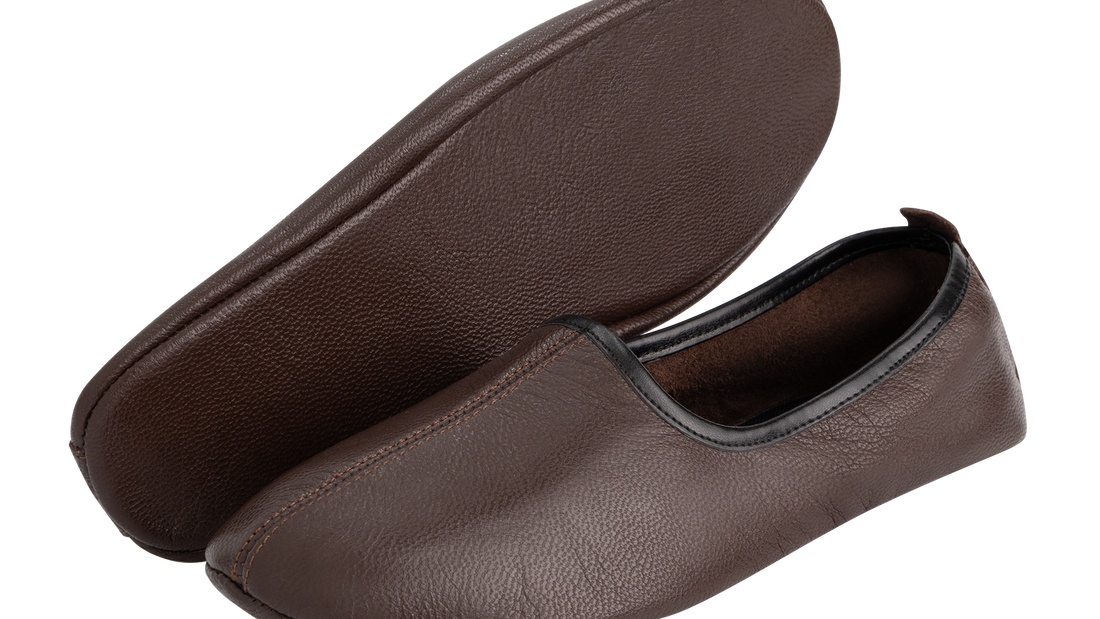
The Tannery Where Our Hides Come From
Every AMUMIN starts its life as a hide in a tannery in Turkey, soaking for weeks in baths of natural plant tannins. No chromium, no accelerants, no shortcuts. This is vegetable tanning — the method that still produces, in our opinion, the only leather honestly fit for a barefoot-style shoe.
What is vegetable-tanned leather?
Vegetable tanning uses plant-based tannins — naturally occurring compounds found in tree bark, leaves and fruits — to convert raw hide into stable leather. It is an old method, practised around the Mediterranean for a very long time. The tannins bind to the collagen in the hide, preserving it against rot while keeping the fibre structure open. The result is leather that breathes, softens with use, and patinas into something unique to the wearer.
The difference with chrome tanning
Chrome tanning, invented in the 19th century, uses chromium salts to fix the hide in roughly a day. It accounts for most of the world's leather production today. It is fast, cheap, and produces a predictably uniform product.
The trade-offs are chemical and tactile. Chrome-tanning effluent is a well-documented contributor to water pollution in regions where tanneries are poorly regulated. Vegetable tanning, by contrast, produces effluent that is largely organic and biodegradable.
For the wearer, the difference is also something you can feel. Chrome leather tends to feel slightly plasticised and does not really patina; vegetable-tanned leather starts firmer, relaxes within weeks, and develops a living surface. It also smells different — warmer, woodier, more like the hide it came from.
Our tannery
We work with a family-run tannery in Turkey that specialises in vegetable tanning. It is not a large operation. They prefer to stay out of marketing, so we keep their name private, but we know them, we visit, and we buy directly rather than through agents.
Working with a small tannery means we have a real conversation about hide quality, batch variation and timing. It also means we are one of a handful of customers they know by name. That relationship matters more to us than a louder, more generic supply chain would.
How hides are selected
Not every hide becomes a shoe. Our tannery receives cattle hides as a by-product of the regional meat industry — no animal is raised for leather. Each hide is inspected in the wet stage for thickness, grain quality, scarring and brand marks. Only the hides that meet our grade become uppers; the rest go to other uses where some imperfection is acceptable. What we look for:
- Consistent thickness across the back
- Minimal insect bites or brambles
- No chemical burn marks
- Even grain without loose neck wrinkles
The tanning time
Once selected, the hide enters a series of baths with natural plant tannins, moving through increasing concentrations over several weeks. The process is not rushed — the tannins have to migrate gradually into the core of the hide without over-tightening the surface. Thicker hides, destined for our outdoor Terra, take longer than lighter hides for the Sereen.
After tanning, the hide is rinsed, dried slowly (never heat-forced), and finished with natural oils and waxes. No pigment dips, no plastic coating.
Final quality
A finished vegetable-tanned hide has three properties that matter for shoes. First, it breathes: water vapour from the foot can pass through the fibre matrix, which is why our shoes do not need synthetic moisture wicking. Second, it conforms: within a few weeks of wear it moulds to the foot's shape. Third, it ages visibly — pale leather deepens into warm honey tones over time, shaped by the person wearing it.
Why this matters for barefoot
A barefoot-style shoe is designed to let the foot do its natural work. That requires a material that moves with the foot and lets it breathe. A stiff, plastic-coated leather would defeat the purpose just as much as a rigid synthetic. Vegetable-tanned hide is soft enough to flex through the metatarsal bend, tough enough to protect the skin, and open enough to vent moisture — the three non-negotiables.
It is also a material made with care, from a small number of honest hands, intended to last. That matches how we want to make shoes. We are not trying to win on price or speed. We are trying to make something a person can wear for years, repair when it needs repairing, and still enjoy at the end.
If you want the full picture of how this leather then becomes a shoe, read our piece on how we make a pair by hand. If you are curious about the logistics — how hides actually travel from the tannery to your door — see our Rotterdam–Bursa route article. The finished shoes live at our collection, and more about us is on the about page.