
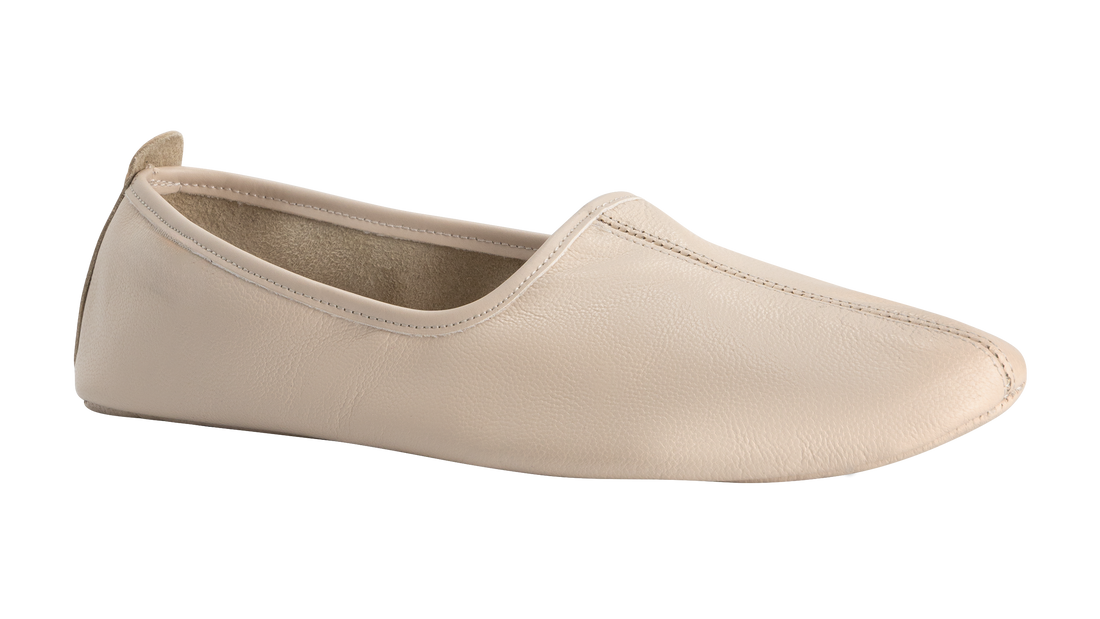
How AMUMIN Makes Handmade Leather Shoes: The Full Process
There are two ways to make a leather shoe. You can stamp, glue and ship thousands of pairs a day from a large factory, or you can cut, stitch and last each pair by hand in a small atelier where people know each other. We chose the second path. Not because it is romantic, but because we believe it is the only honest way to make a barefoot-style shoe that actually respects the foot inside it.
This is the story of how a pair of AMUMIN Sereen is made — from raw hide to the moment it leaves our hands.
Why handmade, not factory
Machine production is fast and uniform. It is also indifferent. When a shoe is pressed out at machine speed, the leather is rushed, the stitching is set at a tension the hide did not negotiate, and the last is engineered for a theoretical average foot that does not exist.
Handmade means someone touches the leather before it touches you. They feel whether the grain is dry, whether the stitch is biting, whether the insole is sitting flush. A machine cannot notice a thin patch on the vamp. A craftsperson always does. That is the whole argument: quality you can feel, and a craft tradition that stays alive because real people still practise it.
The material: vegetable-tanned Turkish leather
Everything starts with the hide. Ours is vegetable-tanned leather from Turkey — tanned with natural plant tannins rather than chromium salts. It is a slower, older method, and it gives us a leather that breathes, softens with wear, and patinas into something better-looking at year five than at year one.
Vegetable-tanned leather is not the easiest material to work with. It is less forgiving than chrome-tanned. But it is the material that lets a shoe behave like a second skin rather than a plastic shell. For a deeper look at the tannery and the process, see our piece on the tannery.
The design: Sereen, Terra, Mini Sereen
Before a knife touches leather, the shoe exists as a sketch and a wooden last. Our core models — the indoor Sereen, the outdoor Terra, and the Mini Sereen for children — were designed around one stubborn constraint: the foot must be allowed to do its job.
That means a wide, anatomical toe box. Zero drop from heel to toe. A sole thin enough to transmit ground feel but tough enough for real walking. No arch support, no motion control, no marketing foam. The last — the wooden mould the shoe is built around — was refined pair after pair until we could walk a full day in it without thinking about our feet. If you want to check fit, our size guide walks you through it.
The process
Once the design is fixed, each pair passes through many small operations. We will not list all of them, but the key ones tell the story:
- Hide selection. Full hides are spread on a table and inspected under daylight. Scars and brand marks are flagged. Only the cleanest sections go to the vamp; the rest becomes lining or is returned.
- Cutting. The cutter places dies on the hide and presses out the pattern pieces. Orientation matters — the grain must run correctly along the length of the foot or the shoe will stretch unevenly.
- Skiving. Edges that will be folded or stitched are thinned by hand. A little too thick and the seam bulges; a little too thin and it tears.
- Stitching. The upper pieces are joined. Visible edges are hand-finished.
- Lasting. The upper is pulled over the wooden last and fixed in place. This is the step that decides whether the shoe holds its shape for years or warps in months.
- Sole attachment. Depending on the model, the sole is stitched or bonded.
- Finishing. Edges are waxed and burnished. The insole is set. The last is pulled.
The remaining steps are the small ones — eyelets, lacing, final inspection, brushing, boxing. They are the steps customers never see and that, done wrong, ruin everything.
Our craftspeople
Our atelier in Bursa is a small team. They are not anonymous "workers" — they are skilled people with families and strong opinions about their tools. When a pair of AMUMIN arrives at your door, one of them put it together with their own hands.
Transport costs and labour costs have risen noticeably over the past period. We accept that. We want the people who make our shoes to be fairly paid, and we would rather keep quality honest than chase a lower price.
Why Bursa
People ask why we do not make in the Netherlands. The honest answer: the depth of leather craft we needed is not here. Turkey has a long-standing leather tradition and Bursa is one of its centres. The apprenticeship chains are intact — skills are still being passed from one generation to the next. That is what we needed, and we could not find it at any price in the Netherlands.
We buy the leather directly from the tannery and work closely with the atelier so they can plan their work. You can read more about the Rotterdam–Bursa route if you want the logistics detail.
The future of the craft
Traditional shoemaking is under pressure everywhere. Fast fashion and petrochemical materials are cheaper and quicker to produce. We are aware we are paddling against that current.
But we also see something else: customers who keep a pair for years and send them back for resoling instead of binning them. Children who grow into their siblings' Mini Sereens. A slow rebuild of the idea that a shoe is an object, not a disposable.
That is why we make shoes this way. If you want to see the full range, it lives at our collection, and the story behind the brand is on our about page.