
Are Shoes Allowed During Tawaf? A Fiqh & Practical Guide
The question
Every year, first-time pilgrims ask the same thing: am I allowed to wear shoes during tawaf, or must I go barefoot? The internet gives contradictory answers. This article presents a measured view that draws on scholarly consensus where it exists and flags disagreement where it does not. Our longer tawaf and umrah footwear pillar guide gives the fuller picture.
A critical distinction: ihram vs regular tawaf
Before anything else, separate two situations that are often conflated.
Tawaf in ihram is performed during the rites of Hajj and Umrah, while the pilgrim is in the sacred state entered at the miqat. Specific dress rules apply — including specific rules about footwear — and they differ for men and women.
Regular tawaf is every other tawaf: visits outside the Hajj and Umrah windows, and tawaf after the Umrah rites are complete. The pilgrim is not in ihram. The ihram footwear rules do not apply. Most tawafs fall into this second category.
If you keep this distinction in mind, the rest follows cleanly.
General fiqh for regular (non-ihram) tawaf
Classical Islamic jurisprudence does not impose an absolute requirement of bare feet for tawaf outside ihram. The majority of scholars across the four Sunni madhahib permit footwear on the condition that the shoes are ritually clean (tahir) and do not disturb the sanctity of the Masjid al-Haram. The Prophet Muhammad ﷺ is reported in sahih hadith to have performed tawaf both barefoot and while riding, which scholars read as a signal of permitted flexibility.
At the same time, barefoot tawaf carries symbolic weight. Removing the shoe is an act of humility and presence, comparable to the removal of footwear before entering a masjid's prayer space.
Hanafi
Hanafi jurists permit clean footwear during tawaf without dislike (karaha) when justified by heat, cold, or injury. In mild conditions, bare feet remain the preferred practice.
Maliki
The Maliki school emphasises bare feet more strongly but permits footwear when the marble would cause genuine harm. Clean shoes are valid; soiled shoes invalidate the tawaf.
Shafi'i
Shafi'i scholars permit footwear during tawaf. Bare feet are sunnah, not obligatory. Several classical texts discuss explicitly the case of hot paving and allow protective footwear.
Hanbali
The Hanbali school is perhaps the most lenient: clean footwear during tawaf is permitted without karaha.
Convergence
All four schools agree that the shoe must be clean, must not drag filth into the mataf, and must not be worn for display. This is a ritual, not a fashion moment.
Ihram rules for men
In ihram, men wear two unstitched white cloths and are bound by additional restrictions. Classical fiqh across all four madhahib prohibits men in ihram from wearing shoes that cover the ankle bones or the top of the foot fully. Men in ihram must wear open sandals that leave the ankle and the top of the foot uncovered.
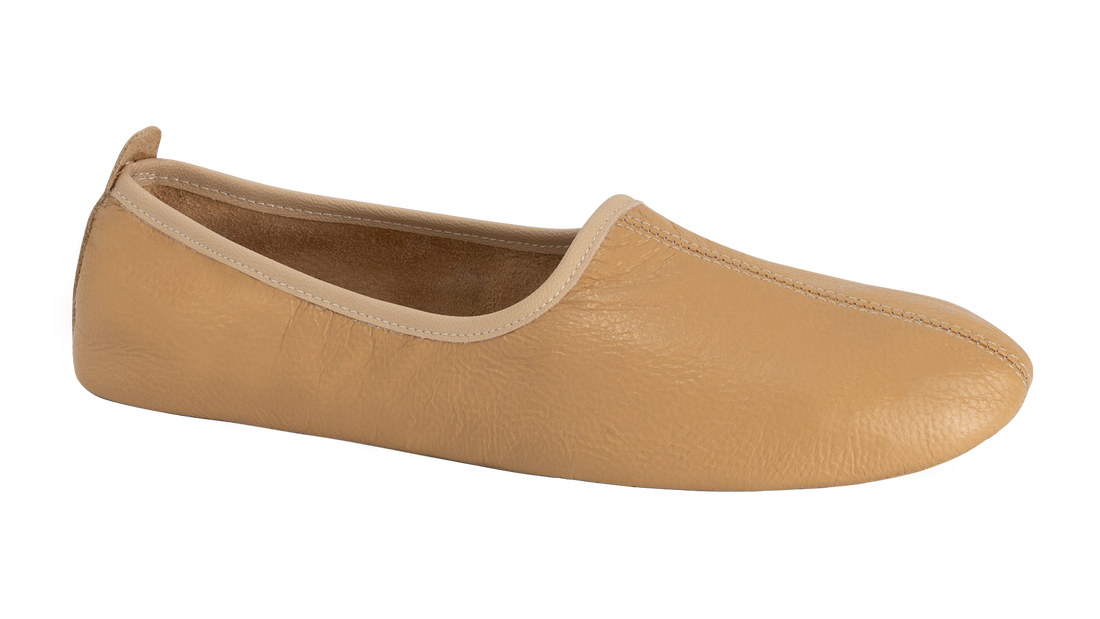
A closed shoe — one that covers the instep — falls on the prohibited side of this line. Our Sereen is a closed leather shoe and therefore not suitable for men in ihram. Men performing tawaf during Hajj or Umrah must use the open sandals that the ihram rules require.
Ihram rules for women
Women have no equivalent footwear restriction in ihram. Across the four madhahib, women may wear fully enclosed footwear during ihram and during tawaf. Sereen is appropriate for women throughout the rites of Hajj and Umrah.
Practical reality: hot marble, crowds, and swelling
The marble of the Masjid al-Haram becomes very hot in summer and surprisingly cold in winter. The Saudi authorities cool much of the inner mataf, but crowding often pushes pilgrims outward onto uncooled stone. Marble also becomes slippery where Zamzam water has been spilled, and feet swell over the course of multiple rounds. These are not imagined risks; they are the typical pilgrim's experience.
Fiqh does not demand that you harm yourself to perform a ritual. Classical scholars repeatedly invoke the principle of raf al-haraj (removal of hardship): protective footwear during tawaf is, for many pilgrims in modern conditions, not merely permitted but prudent — within the dress code that applies to you.
What makes footwear suitable
- Cleanliness. The shoe should be free of najis substances. Vegetable-tanned leather is easier to verify than multi-component synthetics.
- For men in ihram: open sandals. The ankle bones and top of the foot must remain uncovered.
- For regular tawaf and for women: a thin, flexible sole. A barefoot-feel sole preserves the spirit of the ritual while protecting the foot.
- Quiet tread. Hard rubber slaps the marble and disturbs other pilgrims. Soft leather is silent.
- No external branding visible. Respect the place.
AMUMIN's position
We make Sereen as a handmade vegetable-tanned leather shoe with a thin leather sole, silent on stone, designed for indoor wear on marble. To be explicit about the fiqh fit:
- Sereen is for regular (non-ihram) tawaf, for men and women.
- Sereen is for women during Hajj and Umrah, including in ihram.
- Sereen is not for men in ihram. Men in ihram must wear the open sandals their dress code requires.
For walks between sacred sites, where streets are hotter and longer than the mataf, our Terra outdoor shoe is the complementary piece. Many pilgrims buy both together from our Earth Collection.
When in doubt, consult
If you follow a specific scholar or madhhab closely, speak to them before travelling. The positions above are summaries; your particular tradition may have additional nuances. For sizing, see our size guide. For choosing between Sereen and Terra, read our model comparison.
Closing
Tawaf is a meeting between the pilgrim and the House. The shoe question is secondary. But answering it calmly, with respect for fiqh and for your own body, lets you arrive at the mataf ready to circle in peace.